
January 2026 (130.1)
Article
Syncretic Religious Practice at Dedoplis Gora (Caucasian Iberia) in the First Century CE
Monuments discovered through archaeological excavations provide information about the pre-Christian religion in Kartli (Caucasian Iberia, modern Georgia). Particularly remarkable is a grandiose temple complex discovered in central Georgia, where the kings of Kartli worshiped Iranian (Zoroastrian) gods merged with local Georgian astral deities. In the Dedoplis Gora palace, which is located 3 km south of the temple complex, three rooms (N10, N20, N26) yielded sanctuaries. The presence of three household sanctuaries in one building suggests that they had different users. In this article, I suggest that room N10 with an altar was a Zoroastrian-type domestic shrine where permanent residents of the palace of Dedoplis Gora offered daily sacrifices and prayed. Meanwhile, the noble owners of the palace prayed in room N20, based on the luxurious items found on the altar. It is likely that the Zoroastrian altar in room N20 was used to worship the Greek cult of Apollo, based on the statuettes found there. Room N26 may have been used for a ritual related to a local cult of fertility, agriculture, and harvest. Coexistence of different religions in the same household is not surprising in the kingdom of Kartli in the first century.
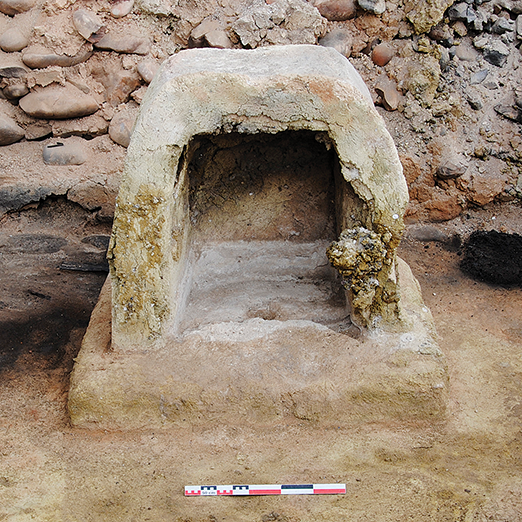
The fire altar, in room N20, Dedoplis Gora palace, looking west (scale = 50 cm) (courtesy I. Gagoshidze).
More articles like this:
Cultural Interaction • Roman Period • Religion/Cult • Hellenistic Period • Asia
The fire altar, in room N20, Dedoplis Gora palace, looking west (scale = 50 cm) (courtesy I. Gagoshidze).