
AJA Open Access
April 2026 (130.2)
Article
Athenian Figure-Decorated Pottery for Whom? A View from Eastern Andalucía (Spain)
Athenian pottery began to arrive in the Iberian Peninsula in significant quantity in the fifth century BCE, with a peak in the fourth century. Both black-gloss and figure-decorated pots were exported, the former being markedly the more common in all the Iberian regions but one: eastern Andalucía. Earlier scholarship has explained the preference of the native communities of that area for vases with images as a case of interpretatio iberica whereby some repetitive Athenian images were particularly favored because they could be assimilated with concepts particular to Iberian society. This article looks further into this question and assesses whether there are any distinctive patterns in the distribution and deposition of red-figure and black-gloss pots in that region and whether the theory of prestige-signaling applies in contexts where red-figure pottery outnumbers black-gloss. Taking as case studies the necropoleis of Galera and Baza, in Granada, and Castellones de Céal, in Jaén, I place the Andalusian exception within the larger context of the consumption of Athenian pottery in Iberia and within its own local context, revealing a world fascinated with images that served the sociopolitical and ritual needs of the Iberians of this region in the momentous passage from life to death.
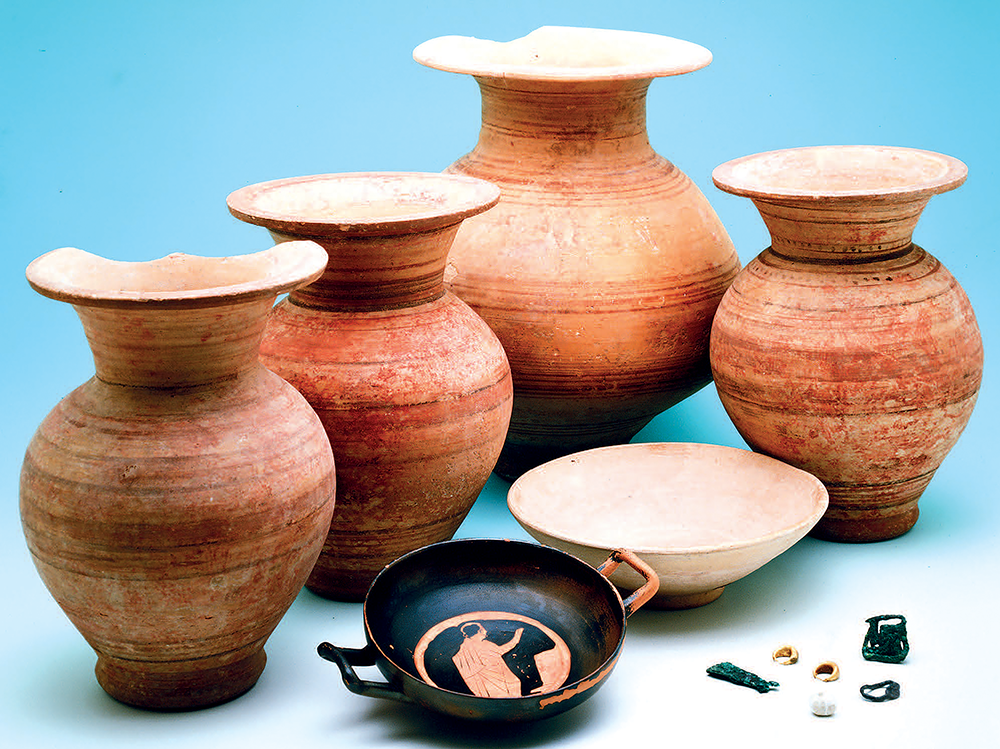
Grave goods from Tomb 11/145 of Castellones de Céal. Museo de Jaén DJ/DA03407, 03408, 03409, 03428, 03411, 03415, 03417, 03418, 03419, 03416, 03420; excav. 1991; all acq. 1991 (© Instituto de Arqueología Ibérica, Universidad de Jaén; CC BY-NC; www.europeana.eu/item/2020738/3DICONS_8658).
More articles like this:
Pottery • Mortuary • Classical Period • Material Culture • Europe > Western Europe
Grave goods from Tomb 11/145 of Castellones de Céal. Museo de Jaén DJ/DA03407, 03408, 03409, 03428, 03411, 03415, 03417, 03418, 03419, 03416, 03420; excav. 1991; all acq. 1991 (© Instituto de Arqueología Ibérica, Universidad de Jaén; CC BY-NC; www.europeana.eu/item/2020738/3DICONS_8658).