
January 2026 (130.1)
Article
Marble Wall Revetment in Roman Times: Materials and Techniques
Making marble wall revetment in Roman times required real know-how. Surprisingly, ancient sources are silent on the installation methods of revetment. The archaeological literature is also sparse, but there are two schools of thought: one assumes that a plaster layer was applied before the marble slabs, while the other assumes that mortar was poured behind the slabs held in place by metal clamps. All point out the presence of shims on the plaster, although there has been no consensus as to their function. The recent discovery of an organic material (based on pitch and beeswax) helps us understand how these shims were laid: they were placed behind the slabs, before the slabs were installed, to hold them in place when the mortar set. Above all, it provides a clear understanding of how the Romans went about installing their marble revetment: choosing one or other of the two supposed variant methods as required. This synthesis also gives us the opportunity to present a typology of metal clamps and to discuss several adaptations of the technique, such as the practice at Pompeii of preparing the wall surface with a toothed chisel.
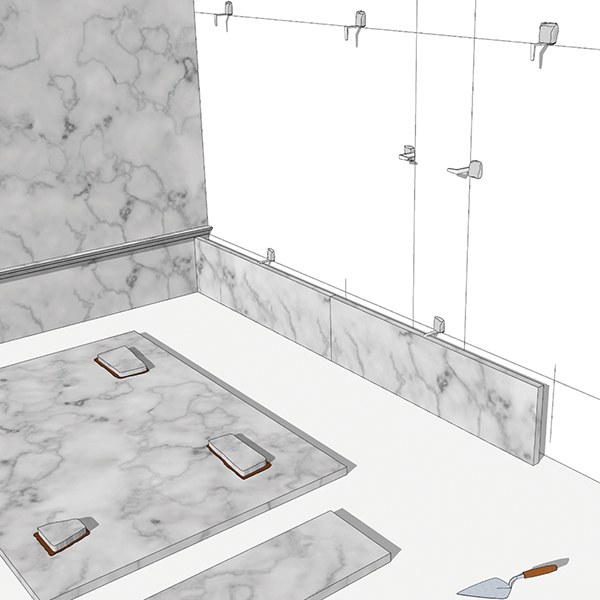
Hypothesis for the installation of wall revetment, variant A, step 4: the slabs are clamped in position before the mortar is poured behind them (drawings by S. Coutelas).
Hypothesis for the installation of wall revetment, variant A, step 4: the slabs are clamped in position before the mortar is poured behind them (drawings by S. Coutelas).