
April 2026 (130.2)
Article
Romulus, the Pantheon, and Decastyle Buildings in Imperial Rome
The decastyle temple preserved on two Early Imperial reliefs from Rome can be identified as Agrippa’s Pantheon, and they indicate that the building’s pediment featured three scenes from Romulus’ life: Mars and Rhea Silvia, the Lupercal, and probably the divinized Romulus/Quirinus. Such a program highlighted the central Campus Martius as the site of Romulus’ apotheosis, while also establishing a link between Romulus and Augustus, whose Mausoleum was axially aligned with the Pantheon. The Pantheon’s second-century CE reconstruction shifted the plan from decastyle to octastyle because the insertion of a colonnaded court at the north required a narrower facade. Hadrian’s new temple of Venus and Roma therefore served as the city’s only decastyle building, and it, too, was tied to Romulus as the staging area of the new Romaea festival on 21 April. The decastyle temple on the Quirinal built by Septimius Severus (193–211 CE) was probably dedicated to his tutelary gods, Hercules and Liber Pater, who were linked to Romulus through the temple’s decastyle format and by its location near the temple of Quirinus. As the empire progressed, the decastyle format gradually acquired its own symbolism, one that pulled the imperial sponsor into the same sphere as the legendary city founders.
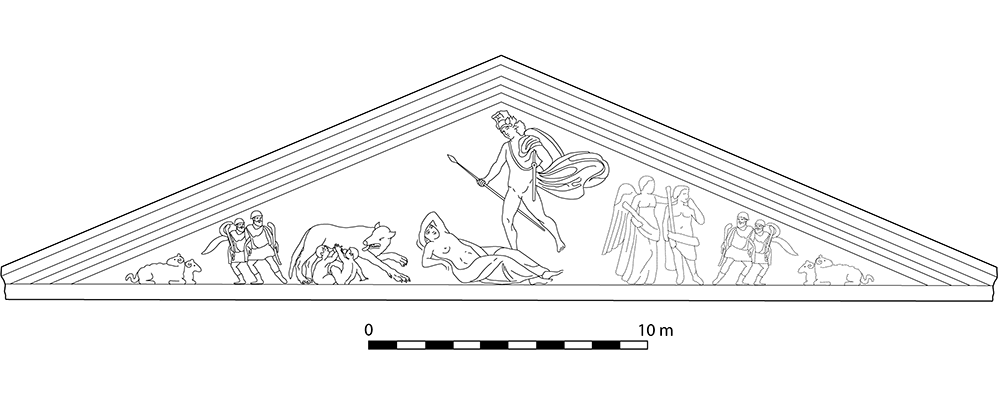
Reconstruction of pediment with scenes from the life of Romulus, after the Museo Nazionale Romano delle Terme relief, with conjectured figures toward the right shown in lighter outlines (drawing by A. Anderson).
Reconstruction of pediment with scenes from the life of Romulus, after the Museo Nazionale Romano delle Terme relief, with conjectured figures toward the right shown in lighter outlines (drawing by A. Anderson).