
October 2026 (130.4)
Article
Shopping Local and Trusted Traders: Identifying Production Zones and Trade Routes of Northern Italian Terra Sigillata Using Similarity Indices
By James Page
Italian Terra Sigillata (ITS) was one of the most widely traded fine wares in the Roman world, seeing distribution across the Mediterranean and beyond. Northern Italian Terra Sigillata (NITS) has rarely been included in wider debates surrounding ITS, with its zones of production, consumption, and trade routes still matters of speculation. To better understand how NITS was produced and traded during the first century BCE and first century CE, an assemblage of 1,844 legible stamps on NITS from 24 sites in Northern Italy was analyzed using the Morisita-Horn Index of similarity. The similarity analysis generated two geographic clusters of sites containing similar NITS stamp assemblages, suggesting that two distinct production zones existed. Further analysis of the stamp assemblages within each cluster demonstrates limited chronological overlap between the two, implying they correspond to different phases of production. This pattern is corroborated by unstamped assemblages. Mapping the distribution of workshop output from each cluster also suggests that this ware was traded over short and long distances by different mechanisms. Within Northern Italy, it was primarily consumed a short distance from where it was produced, with little regional circulation. In contrast, output from both identified production zones had similar long-distance distribution to sites in the Balkans.
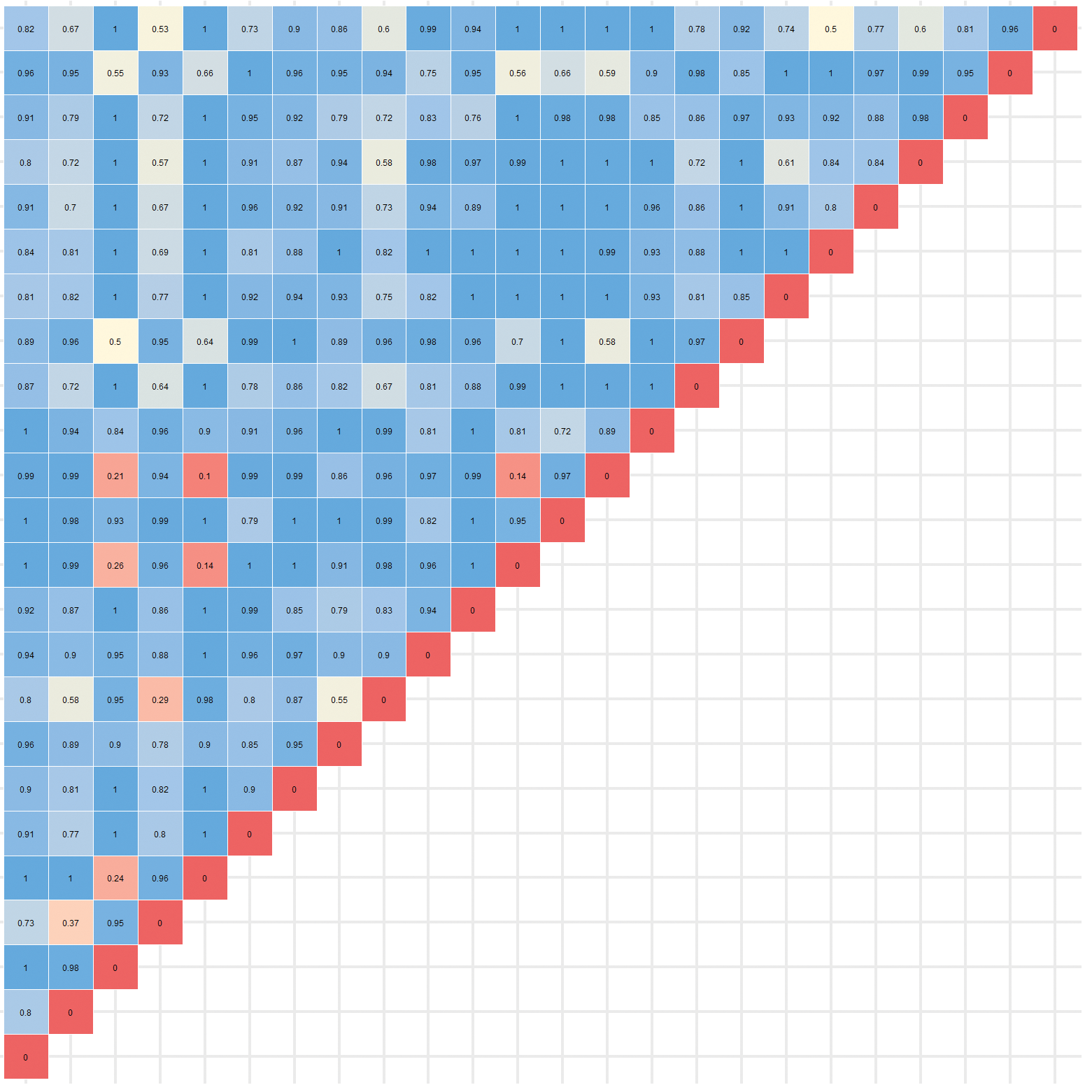
Distance matrix of Morisita-Horn Index of similarity scores for Northern Italian stamp assemblages in the dataset; red = sites with higher similarity; blue = sites with lower similarity.
Distance matrix of Morisita-Horn Index of similarity scores for Northern Italian stamp assemblages in the dataset; red = sites with higher similarity; blue = sites with lower similarity.