
April 2026 (130.2)
Article
The Impermanence of Death: Tomb Reopening and Reuse in Central Apulia in the Fifth and Fourth Centuries BCE
By Bice Peruzzi
This article discusses evidence from Central Apulian necropoleis between the sixth and fourth centuries BCE to illustrate three forms of post-depositional interactions with the dead: tomb reopening for goods retrieval, the construction of residential buildings above preexisting graves, and repeated reuses of ostensibly single-deposition tombs. These practices have often been explained away as a matter of convenience or lack of piety. I argue that although they might appear destructive, they did not have necessarily negative connotations. By repeatedly engaging with the physical remains of predeceased members of their communities, the inhabitants of this region were able to blur the boundaries between past generations and their present, alternately rejecting, incorporating, and reinventing shared memories. Understanding these behaviors goes beyond the study of funerary practices, as they can be used also to expand our limited knowledge of the structures of the community (e.g., families, clans, and other forms of kin groups) and various aspects of religion, such as ancestor worship.
Content warning: Readers are advised that this article contains a photograph of human remains.
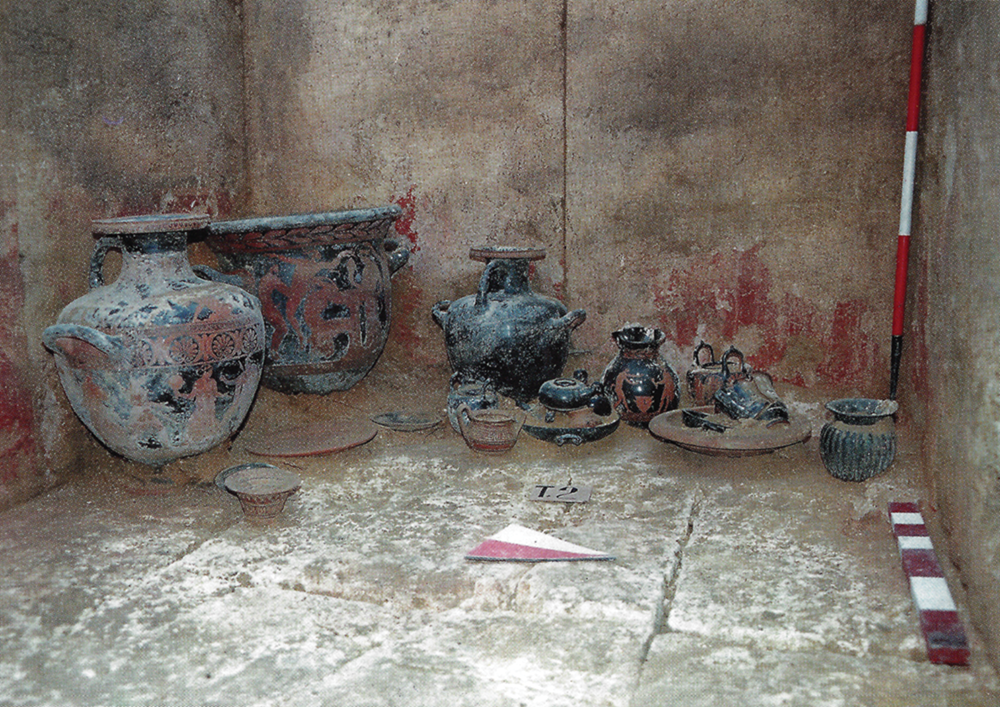
Gravina-Botromagno. Interior of Tomb Bt. 2/1994 with part of the pottery assemblage in situ (410–390 BCE) (Ciancio 1997, fig. 99).
Gravina-Botromagno. Interior of Tomb Bt. 2/1994 with part of the pottery assemblage in situ (410–390 BCE) (Ciancio 1997, fig. 99).