
January 2026 (130.1)
Article
Plaster Casts of the Portico from Aphrodisias: Archaeology, Politics, Museology
By Claudia Cecamore, Julia Lenaghan, Chiara Marabelli, and Milena Melfi
This article presents a case study that demonstrates three essential uses—archaeological, political, and museological—of plaster casts in Graeco-Roman studies. The case is the Portico of Tiberius at Aphrodisias, which the Italian archaeological mission in Anatolia excavated in 1937. Casts of the architectural elements of the portico (entablature, capital, and column) were made immediately, shipped to Rome, and employed to create a one-to-one plaster reconstruction (7.5 m tall, 5.8 m wide, and 1.6 m deep) for a Fascist-period exhibition in Rome, the Mostra Augustea della Romanita. Notwithstanding its Tiberian-period inscription, there the portico was deliberately interpreted as an Augustan monument, with a clear political intent. Both the plaster fragments and the reconstruction today belong to the collection of the Museo della Civiltà Romana in Rome. These objects are extraordinary in their versatile functions—as three-dimensional documentary replicas, propagandistic tools, and a decontextualized museum exhibit—and in their capacity to represent and misrepresent their sources.
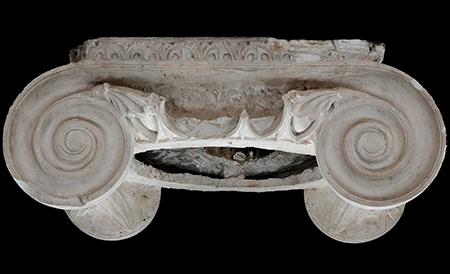
Example of a cast of an Ionic capital made by Paolini in 1937–38 at Aphrodisias. Rome, Museo della Civiltà Romana 5619 (courtesy Museo della Civiltà Romana).
More articles like this:
Cultural Interaction • History of Archaeology • Museology/Museum studies • Cultural Heritage • Turkey > Southern Turkey
Example of a cast of an Ionic capital made by Paolini in 1937–38 at Aphrodisias. Rome, Museo della Civiltà Romana 5619 (courtesy Museo della Civiltà Romana).