
July 2026 (130.3)
Article
Modeling Ritual Communication: Sound and Sight in the Principia of the Roman Legionary Fortress at Novae
By Kamil Kopij, Tomasz Dziurdzik, Adam Pilch, Monika Drab, and Szymon Popławski
While Roman military oratory is popularly depicted as impromptu battlefield speeches, most official communications occurred within the formalized spaces of the camps, predominantly at the principia (headquarters). The social significance of ritualized ceremonies is generally acknowledged, but little quantitative research has examined how architectural layout affected soldiers’ sensory access to these events. This study analyzed the third-century principia at Novae (Bulgaria) using 3D computer modeling and GIS-based viewshed analyses to identify zones of visibility for gestures and facial expressions, complemented by acoustic simulations and crowd capacity estimates based on empirical density factors. Results from five locations indicate that the paved area in the forum militare, likely containing the altar, provided optimal conditions for ceremonial delivery, balancing visibility and audibility for thousands of participants. Conversely, the aedes, despite its symbolic importance, offered limited acoustic reach, reinforcing its role as a sacred space for select audiences. These findings demonstrate that Roman military architects deliberately differentiated spatial zones to modulate sensory experience and ritual engagement, enabling both mass participation and hierarchical control. This approach advances understanding of Roman military ceremony while offering a transferable framework for analyzing embodied rhetoric in ancient built environments, revealing the sophisticated relationship between architecture and communication in Roman military culture.
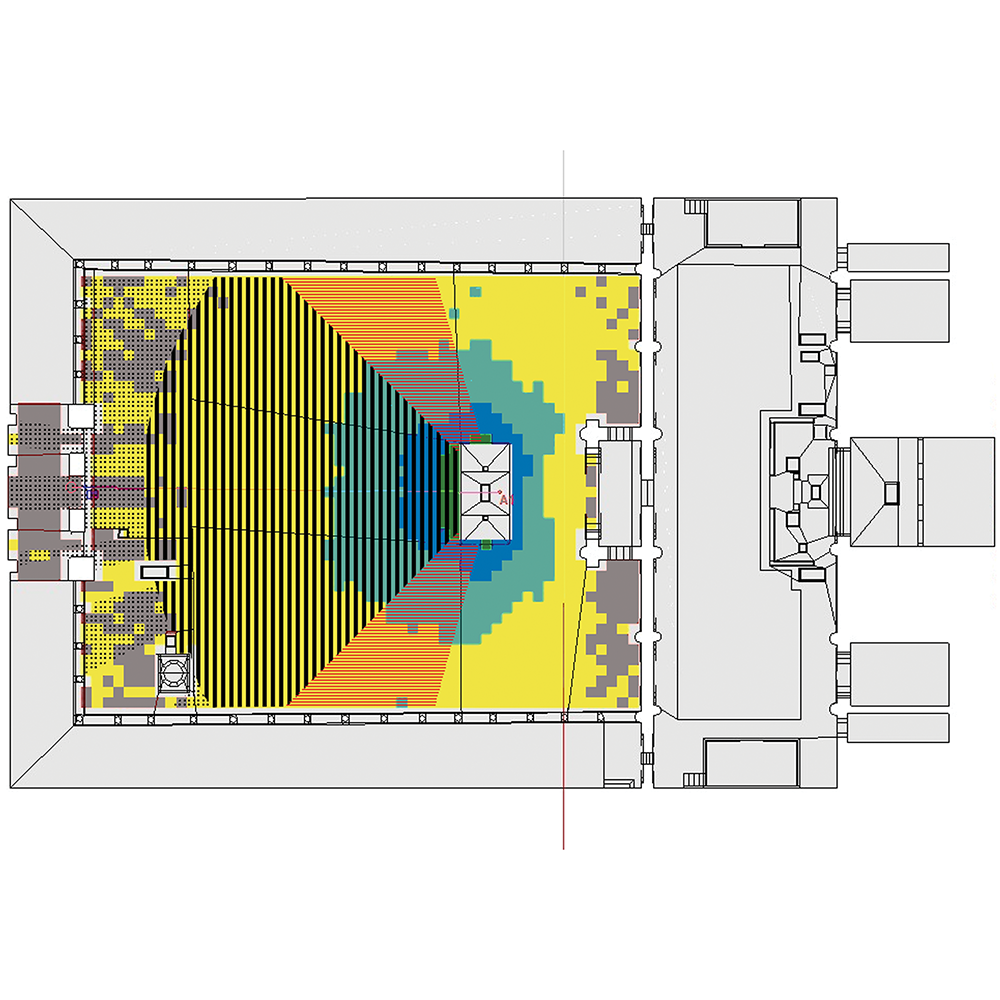
Overlaid results of acoustic simulations (Speech Transmission Index, STI) for typical audience noise (TAN) level and analyses of facial and gestural visibility with the speaker in paved area of the forum militare and no access to porticoes.
Overlaid results of acoustic simulations (Speech Transmission Index, STI) for typical audience noise (TAN) level and analyses of facial and gestural visibility with the speaker in paved area of the forum militare and no access to porticoes.