
AJA Open Access
October 2026 (130.4)
Field Report
Castellaraccio di Monteverdi (Civitella Paganico, Grosseto): A Deserted Medieval Village of the Ardenghesca
By Alessandro Sebastiani, Alessandro Carabia, Cleo Barbafiera, Massimo De Benetti, Marta De Pari, Matteo Penco, Luisa Russo, and Alessandra Serra
This article presents the results of six years of archaeological excavations at Castellaraccio di Monteverdi, a minor fortified settlement in the middle valley of the Ombrone River in southern Tuscany. Previously known almost exclusively through 12th- and 13th-century CE documentary sources, the site now provides a tightly dated archaeological sequence that permits a reassessment of the foundation, function, and abandonment of a short-lived hilltop center within a contested territorial landscape. Excavations conducted by the IMPERO Project document episodic use of the hilltop in the Hellenistic period and possibly the early Middle Ages, with no evidence of structural or demographic continuity. The data place the formal establishment of the castle between the late 11th and early 12th centuries CE, followed by architectural investment, spatial reorganization, and economic specialization focused on storage and infrastructural control, including a bridge across the Ombrone River. Stratigraphic, architectural, and environmental evidence show that Castellaraccio was not a marginal or failed settlement but a selectively invested seigneurial site rendered redundant by planned territorial reorganization, particularly the foundation of the borgo franco of Paganico in 1292. Sporadic 14th-century reuse complicates narratives of abrupt abandonment and highlights archaeology’s role in reassessing models of incastellamento in medieval Tuscany.
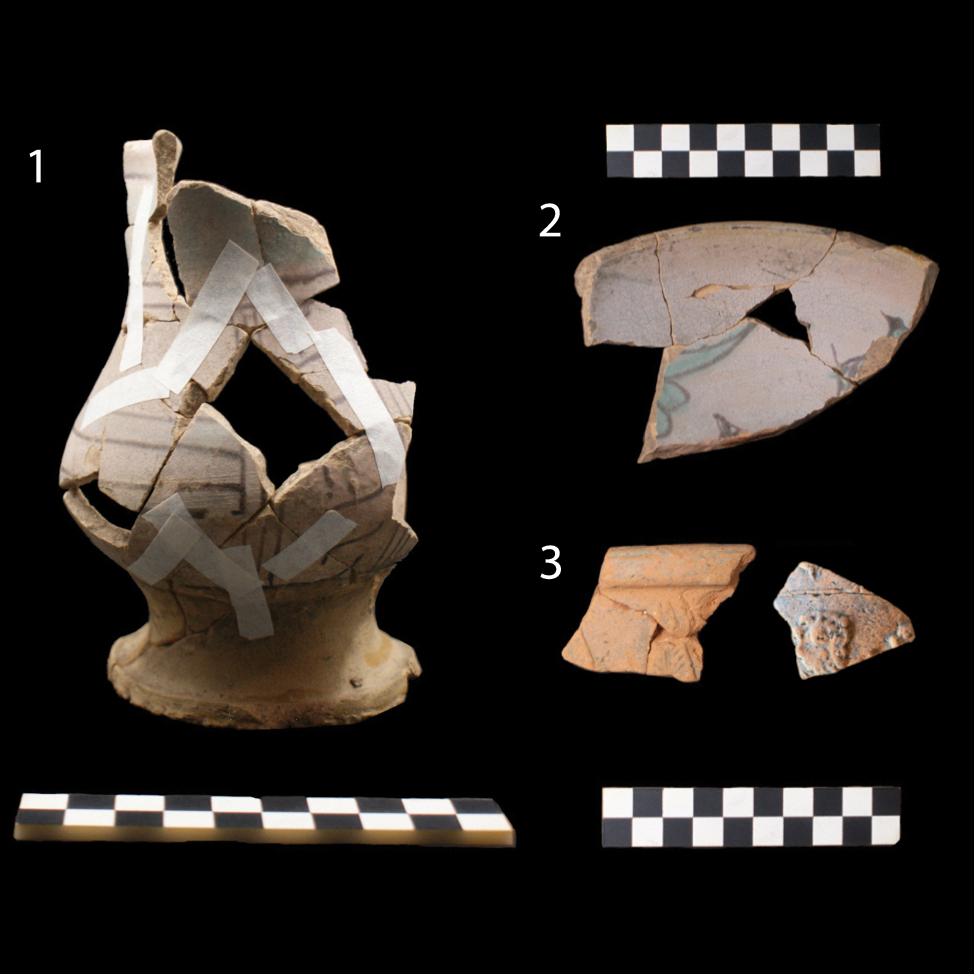
Selected examples of archaic maiolica and moldmade forms: 1, jug in archaic maiolica; 2, bowl in archaic maiolica; 3, fragments of figlinese ware.
More articles like this:
Settlement Patterns • Architecture • Excavation • Material Culture • Italy > Tuscany
Selected examples of archaic maiolica and moldmade forms: 1, jug in archaic maiolica; 2, bowl in archaic maiolica; 3, fragments of figlinese ware.